
The damp floor
Hampton Roads, VA
Camel Crickets in Hampton Roads
Humpbacked, leggy, silent, and prone to jumping straight at you: the camel cricket is the unofficial mascot of the Hampton Roads crawl space.
Determination
Ceuthophilus and Diestrammena species
Humpbacked, wingless, silent, and jumping straight at you. Then read the crawl space, not the cricket.
- Common name
- Camel Crickets
- Report status
- Not a WDI species
- Structural risk
- Nuisance and health
- Settled by
- Moisture reading
- Lives in
- Crawl space
- Field indicators
- 4 listed
Description
Ask a Hampton Roads homeowner about the big spidery crickets in the garage and you will usually get a shudder. Camel crickets are wingless, humpbacked, and mostly legs, with antennae longer than the body and hind limbs built for startling leaps. They never chirp, because they carry no sound organs, and when alarmed they often jump straight toward the threat. It is the bluff of a nearly blind insect, and it works on almost everyone.
They earn their page here for one reason: camel crickets cannot survive dry air, and the vented crawl spaces under most local homes deliver exactly what they need, because the vents meant to dry the space pull in humid summer air instead. A crawl space full of camel crickets is a crawl space holding moisture, and the ones you meet in the basement, garage, or laundry room are overflow from the population below. Many of the crickets in area homes are greenhouse camel crickets, an introduced species that has quietly become the common one in basements across the eastern US.
Ground section
The insect is a symptom of a damp crawl space
The size of the population is the reading. The section below is where the water it depends on sits.
Vent line
Meant to dry the space. Pulls humid summer air in instead.
Crawl space air
Where the population lives.
Standing water or failed barrier
What is feeding them.
Camel crickets a sealed, dehumidified crawl space can support
Field indicators
Evidence, in the order it is usually found
Nothing on this list is a sound. This is an insect you only ever meet by seeing it, or by moving something it was under.
- Large, leggy, humpbacked crickets in the garage, basement, or crawl space
- Sudden leaps toward you when a box or tarp gets moved
- Chewed spots on cardboard, stored fabric, or paper
- Indoor numbers climbing in late summer and fall
Grade level
Where it lives in the structure
Two bands, and one of them is only the spill. Everything about this species points at the same place.
Roof and attic
Not found here
Living space
The ones you meet in the basement, garage, or laundry room are overflow from the population below.
Exterior wall, trim, and deck
Not found here
Sill, band, and floor framing
Not found here
Crawl space
The population itself. A crawl space full of camel crickets is a crawl space holding moisture.
Soil and grade
Not found here
Consequence
What it costs to ignore
The crickets themselves are close to harmless. What they are telling you is not.
Direct
They do not bite people or pets. A heavy population will nibble cardboard, stored fabric, and paper and leave droppings on whatever it crosses.
The signal
A crawl space damp enough for camel crickets is damp enough for fungus and wood decay.
The spray answer
With camel crickets the spray is the smaller half of the job, so a spray subscription treats the population and leaves the cause running.
Corrected condition
A crawl space camel crickets cannot live in
This is the durable answer for this species, and it is the only page in the library where the correction is not primarily a treatment.
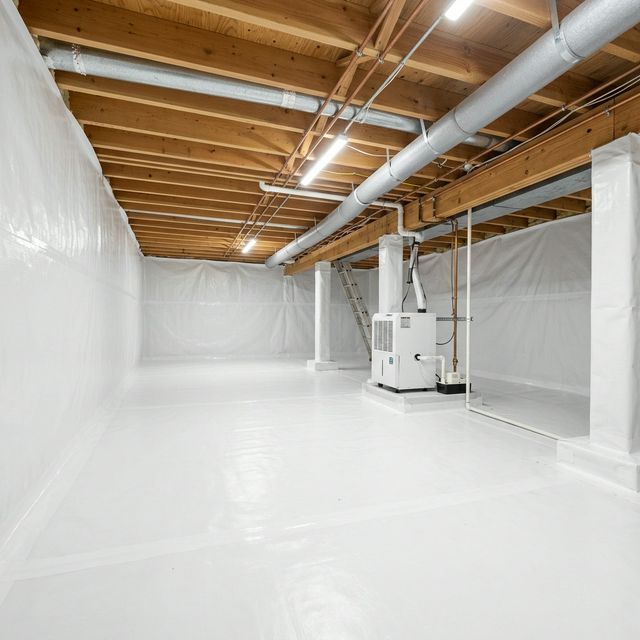
- 1 Floor framing overhead
- 2 Sealed wall liner
- 3 Dehumidifier
- 4 Liner over the ground
Correction
What we do about it
Knock the population down, then take away the water it was living on.
- The smaller half of the job
Treat the harborage
We treat the harborage zones and knock the population down, but with camel crickets the spray is the smaller half of the job.
- Wood moisture, not air
Read the crawl space
They are a moisture indicator first and a pest second, so we inspect the crawl space, take wood moisture readings, and find what is feeding them: standing water, a failed vapor barrier, or vents streaming humid air under the house.
- The population collapses
Dry it and stop
Dry the crawl space and the population collapses on its own. That is why the durable answer is usually moisture control or full encapsulation rather than a spray subscription; a sealed, dehumidified crawl space is a place camel crickets cannot live.
Not sure what you are looking at? Take a photo, save a sample if you safely can, and call 757-583-4444. Identification comes first, and it is free.
See also
Related services
Answered already
Camel Crickets: quick answers
Do camel crickets bite or damage anything?
They do not bite people or pets. A heavy population will nibble cardboard, stored fabric, and paper and leave droppings on whatever it crosses. The bigger cost is what they signal: a crawl space damp enough for camel crickets is damp enough for fungus and wood decay.
Why do they jump at me instead of away?
Poor eyesight and no other defenses. The startle leap fires in a more or less random direction, which sometimes means directly at you. Unnerving, yes. An attack, no.
Camel Crickets
Think you have camel crickets?
Send a photo or book an inspection. We will identify what it is, what it is doing, and what fixing it takes.
757-583-4444Monday to Friday, 9 AM to 5 PM. Norfolk, Virginia Beach, and all of Hampton Roads.