
Above grade, arrival
Hampton Roads, VA
Termite Inspections That Go Under the House
Detection is our first name. A licensed inspector crawls the crawl space, reads the wood, and tells you the truth about what is happening down there.
Most of Hampton Roads lives over a crawl space, and the crawl space is where termite stories start. Eastern subterranean termites nest in soil, build mud tubes up foundation walls and piers, and eat framing from the inside while the living room above looks perfect.
An inspection that stops at a flashlight sweep from the access door is a formality, not a finding. Ours do not stop there, and the crew that finds the damage is the crew that can correct it.
Inspections are free for homeowners who suspect a problem. Finding the issue is how we earn the treatment work, so there is no incentive here to look away and none to invent.
Four reasons this call usually gets made
-
You saw swarming insects or shed wings indoors, especially in spring.
-
You found mud tubes, soft wood, or blistered paint.
-
You are buying or selling and need the official report. See our WDI report service .
-
The home has never been inspected, or not in years.
Plate
Every inspection starts at the door, in daylight, with the light already on.
Interior trim, jambs, and window sills are where a homeowner first sees swarmers and shed wings. It costs four minutes and it decides where we spend the next forty.
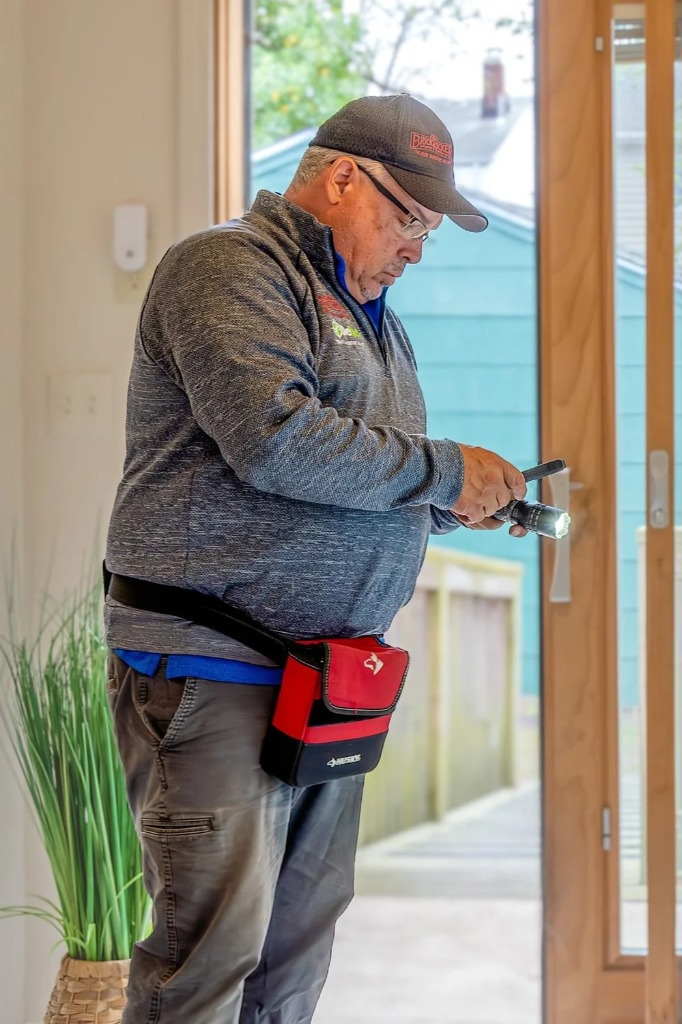
- 1 Open entry, exterior beyond
- 2 Hand light along the jamb
- Typical duration
- 45 to 60 minutes
- Recommended interval
- Annually
- Moisture flag
- Over 20 percent
- Homeowner inspection
- Free
Grade level
Everything under this line is the part most inspections skip, and the part termites have already been using for months.
Under the house
What the inspection covers
Not a checklist read off a clipboard. This is the order the work happens in, from the yard to the far pier and back out with a report.
- Grade, mulch depth, wood to soil contact
The exterior walk, before anything opens
Exterior grade, wood-to-soil contact, stored lumber, mulch depth, and the rest of the conducive conditions get logged first, because the conditions that feed a colony are visible from the yard.
- Where the structure calls for it
Garages, porches, accessible attic framing
A crawl space home is rarely just a crawl space. Attached garages, porch framing, and reachable attic members get the same pass when the structure calls for it.
- A full traverse, not a look from the hatch
Into the crawl space, all the way in
The full crawl space: sills, band boards, joists, subfloor, and every pier we can reach.
An inspection that stops at a flashlight sweep from the access door is a formality, not a finding. Ours do not stop there.
- Live, historic, or already treated
Reading the wood
Mud tubes, live termites, damaged wood, and evidence of past activity or previous treatment. Eastern subterranean termites eat framing from the inside while the living room above looks perfect, so the wood gets read, not glanced at.
- Readings on wood, never on air
Moisture meter on the framing
Meter readings are taken on the framing itself, because wood over twenty percent moisture is an invitation.
- They travel with termite problems
Fungus and wood decay conditions
Decay fungus and the conditions feeding it get recorded in the same pass, because in this region the two problems arrive together and are usually corrected together.
What you get afterward
A plain-language walkthrough of what we found and photos of anything worth seeing, sorted into three columns that matter to you in completely different ways.
- Active
- Live activity, happening now, priced on the spot if treatment is warranted.
- Historic
- Evidence of past activity or previous treatment, with the damage it left behind.
- Condition
- Not a problem yet. A condition worth correcting before it becomes one.
If treatment is warranted we price it on the spot, and if it is not, we say so. Inspectors who invent findings do not keep a 200+ five-star reviews record in a region this small.
Asked at the hatch
Termite inspection questions
Is the inspection free?
If you are a homeowner who suspects a problem, yes: we come look for free, because finding the issue is how we earn treatment work. Real estate closings are different: the official NPMA-33 report is a paid, flat-rate document, and we quote the price when you book.
How long does a termite inspection take?
Plan on roughly 45 minutes to an hour for a typical crawl space home. Large homes, multiple outbuildings, or tight crawl spaces run longer. We would rather take the extra twenty minutes than miss the one pier that mattered.
How often should a Hampton Roads home be inspected?
Annually. Coastal Virginia sits in one of the heavier termite pressure regions in the country, and a year is long enough for a new colony to establish but short enough that damage stays minor. Homes with prior activity or chronic moisture should not skip a year.
Continue the file
Termite Inspection
Book the inspection before the swarm season does it for you
Tell us what you are seeing and we will confirm a time window. Inspections are free when you suspect a problem.
757-583-4444Monday to Friday, 9 AM to 5 PM. Norfolk, Virginia Beach, and all of Hampton Roads.