
Inside the joist
Hampton Roads, VA
Old House Borers in Hampton Roads
Despite the name, this longhorned beetle prefers newer pine framing, and its larvae can feed inside a joist for years before anyone hears them.
Determination
Hylotrupes bajulus
An oval exit hole with ragged edges, and sometimes a rasping sound in a quiet room.
- Common name
- Old House Borers
- Report status
- Reportable on NPMA-33
- Structural risk
- Damages framing
- Settled by
- Hole shape
- Lives in
- Floor framing
- Field indicators
- 4 listed
Description
The old house borer is the most serious beetle pest of structural pine on the East Coast. Females lay eggs in seasoned softwood, and the larvae tunnel through framing for several years, sometimes audibly: homeowners describe a rhythmic rasping or clicking in quiet rooms. Exit holes are oval and about the size of a pencil eraser, with ragged edges, quite different from the neat pinholes of powderpost beetles.
Coastal Virginia is squarely inside this beetle’s range, and it is one of the five wood destroying insects Virginia real estate inspections report. Infestations are less common than termites but harder to detect young, which is exactly why trained eyes matter in the crawl space.
Two beetles, two signatures
Reading the exit hole
Both beetles leave holes in structural wood, and the hole itself is the fastest way to tell which one you are dealing with. These are two different insects, not two options.
Old house borer evidence
Oval and ragged
- Oval exit holes roughly a quarter inch across
- Ragged edges, about the size of a pencil eraser
- Ridged, wavy tunnel walls visible where wood is opened
- Sometimes audible: a rhythmic rasping or clicking in quiet rooms
The most serious beetle pest of structural pine on the East Coast.
Powderpost beetle evidence
Round and neat
- Neat pinhead-size round pinholes
- Talc-fine powder, the consistency of flour
- Evidence sites are flooring, joists, and subfloor
A different determination, and a different page.
Field indicators
Evidence, in the order it is usually found
None of this is a live sighting. Every item here is either something the beetle left behind or something the framing above it started doing.
- Oval exit holes roughly a quarter inch across with ragged edges
- Ridged, wavy tunnel walls visible where wood is opened
- A rasping or ticking sound in framing during quiet hours
- Sagging or springy floors above long-infested framing
Grade level
Where it lives in the structure
This species lives inside the framing rather than on it, so the occupied bands are the ones you cannot see into without help.
Roof and attic
Not found here
Living space
A rasping or ticking sound in framing during quiet hours. Sagging or springy floors above long-infested framing.
Exterior wall, trim, and deck
Not found here
Sill, band, and floor framing
Structural pine framing is the target. Larvae tunnel through it for several years.
Crawl space
Where a trained eye reads the framing, because young infestations are hard to detect.
Soil and grade
Not found here
Consequence
What it costs to ignore
The whole cost of this one lands before anyone notices it, which is what makes it worth looking for.
Years inside
Larvae tunnel through framing for several years before anyone hears them, so the damage is done in silence.
What you feel
Sagging or springy floors above long-infested framing are the point at which the cost stops being theoretical.
On the report
It is one of the five wood destroying insects Virginia real estate inspections report.
Corrected condition
The framing, lit and reachable
Detecting this beetle young means reading the framing itself. A crawl space that has been dried and cleared is a crawl space an inspector can work in.
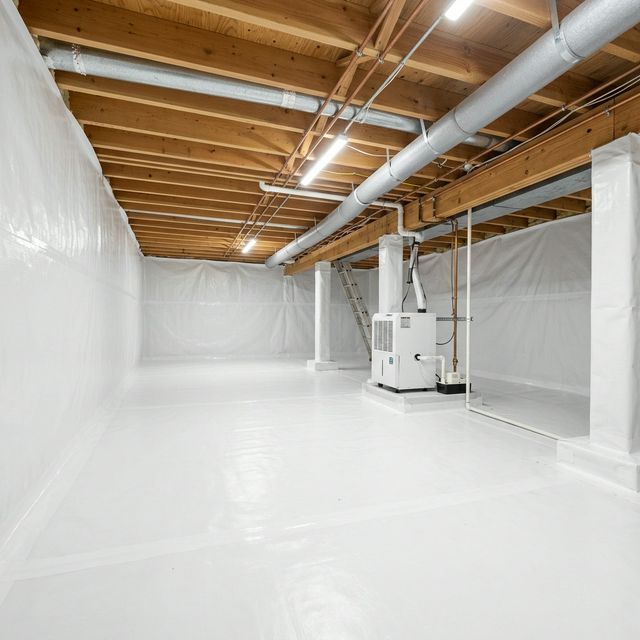
- 1 Floor framing overhead
- 2 Sealed wall liner
- 3 Dehumidifier
- 4 Liner over the ground
Correction
What we do about it
Separate old emergence evidence from live activity, then treat what is there.
- Before recommending anything
Distinguish old from live
Our inspections distinguish old emergence evidence from live activity before recommending anything.
- Borate, and replacement
Treat accessible framing
Confirmed active infestations call for borate treatment of accessible framing and, in serious cases, targeted replacement of compromised members.
- Larvae develop faster in damp wood
Slow the development
Because larvae develop faster in damp wood, crawl space moisture control lowers both the odds of infestation and the pace of damage.
Not sure what you are looking at? Take a photo, save a sample if you safely can, and call 757-583-4444. Identification comes first, and it is free.
See also
Related services
Answered already
Old House Borers: quick answers
How would I even know if I have old house borers?
Honestly, you probably would not until emergence or serious damage, which is the point of professional inspections. If you hear consistent rasping in walls or floors, or find oval exit holes with ragged edges, call us to evaluate before assuming the worst.
Old House Borers
Think you have old house borers?
Send a photo or book an inspection. We will identify what it is, what it is doing, and what fixing it takes.
757-583-4444Monday to Friday, 9 AM to 5 PM. Norfolk, Virginia Beach, and all of Hampton Roads.