
Vent to attic
Hampton Roads, VA
Rodent Control in Hampton Roads
Traps catch rodents. Sealing the building is what ends the problem, and the crawl space is where both jobs usually start.
Determination
Mus musculus and Rattus norvegicus
Droppings, gnaw marks, and the size of the gap they came through.
- Common name
- Rodents
- Report status
- Not a WDI species
- Structural risk
- Nuisance and health
- Settled by
- Entry point
- Lives in
- Crawl space
- Field indicators
- 5 listed
Description
House mice and Norway rats move indoors every fall across Hampton Roads, following warmth and food smell through gaps as small as a dime for mice and a quarter for rats. Crawl space vents with torn screens, gaps at pipe penetrations, and garage door corners are common entry points. Once inside, rodents chew wiring, tunnel insulation, and leave droppings that contaminate everything they cross.
Rodents also intersect with the rest of our work: they shred crawl space vapor barriers, burrow along foundations, and their activity often gets discovered during termite inspections. A crawl space we encapsulate gets rodent-resistant sealing as part of the package.
Field indicators
Evidence, in the order it is usually found
Rodent evidence is unusually honest. Every item on this list points at a route, and the route points at the entry point.
- Droppings along walls, in cabinets, or across attic insulation
- Gnaw marks on wiring, stored goods, or plastic pipes
- Scratching or scurrying in walls and ceilings at night
- Greasy rub marks along baseboards and joists
- A shredded or tunneled crawl space vapor barrier
Two rodents, two gap sizes
House mouse or Norway rat
The determination that changes the work is the size of the opening, because exclusion is sized to the animal. Both of these move indoors every fall across Hampton Roads.
House mouse
Through a gap as small as a dime
- Follows warmth and food smell indoors every fall
- Night scratching in walls or ceilings is most often mice
- Droppings along walls, in cabinets, or across attic insulation
Every dime-sized gap has to be found and closed, not most of them.
Norway rat
Through a gap as small as a quarter
- Burrows along foundations
- Greasy rub marks along baseboards and joists
- Gnaw marks on wiring, stored goods, or plastic pipes
Larger openings, and usually a route that starts at ground level.
Grade level
Where it lives in the structure
This is the widest column in the library, which is the point: rodents use the whole section, and the crawl space is where both jobs usually start.
Roof and attic
Droppings across attic insulation, and scratching near the roofline.
Living space
Scratching or scurrying in walls and ceilings at night. Gnaw marks on wiring and stored goods.
Exterior wall, trim, and deck
Garage door corners, one of common entry points.
Sill, band, and floor framing
Not found here
Crawl space
Crawl space vents with torn screens and gaps at pipe penetrations. A shredded or tunneled vapor barrier.
Soil and grade
Burrowing along foundations.
Consequence
What it costs to ignore
Rodents intersect with the rest of our work more than any other pest on this list.
Wiring
Once inside, rodents chew wiring, tunnel insulation, and leave droppings that contaminate everything they cross.
Crawl space
They shred crawl space vapor barriers and burrow along foundations, so a moisture correction can be undone by a rodent problem nobody addressed.
The opening
They follow warmth and food smell through gaps as small as a dime for mice and a quarter for rats, so the openings that matter are easy to walk past.
Corrected condition
A crawl space with nothing to shred
Rodent activity often gets discovered during termite inspections, and it undoes moisture work. A sealed crawl space is both the correction and the prevention.
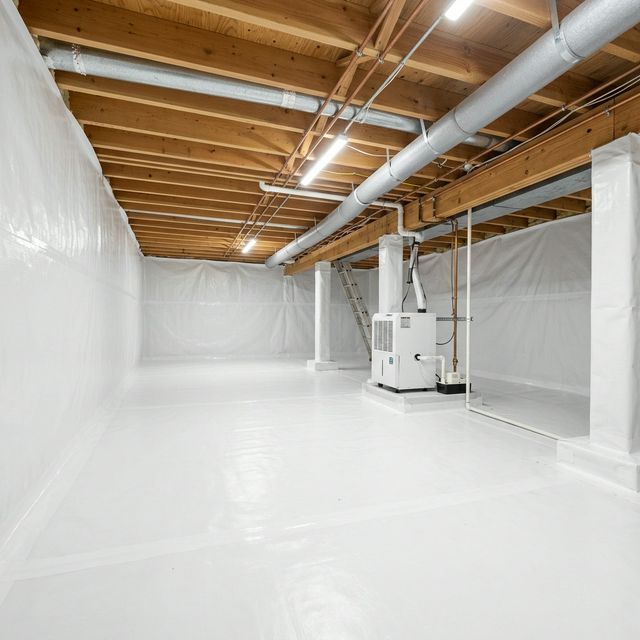
- 1 Floor framing overhead
- 2 Sealed wall liner
- 3 Dehumidifier
- 4 Liner over the ground
Correction
What we do about it
Exclusion first. Traps catch rodents, but sealing the building is what ends the problem.
- Rodent-proof materials
Seal the building
Exclusion comes first: find and seal every entry point with rodent-proof materials, then trap out the animals already inside, then verify with follow-up.
- Sealing is what ends it
Not a bait subscription
Baiting alone without sealing is a subscription to the problem, and we would rather solve it.
- Part of the package
Seal the crawl space with it
A crawl space we encapsulate gets rodent-resistant sealing as part of the package.
Not sure what you are looking at? Take a photo, save a sample if you safely can, and call 757-583-4444. Identification comes first, and it is free.
See also
Related services
Answered already
Rodents: quick answers
I hear scratching at night but never see anything. Mice?
Night scratching in walls or ceilings is most often mice, sometimes rats, and occasionally squirrels near the roofline. An inspection of the attic, crawl space, and exterior tells us which, and the entry points usually make the answer obvious.
Rodents
Think you have rodents?
Send a photo or book an inspection. We will identify what it is, what it is doing, and what fixing it takes.
757-583-4444Monday to Friday, 9 AM to 5 PM. Norfolk, Virginia Beach, and all of Hampton Roads.