
Damp air
Hampton Roads, VA
Silverfish in Hampton Roads
The gray, wriggling insect in the tub at 2 AM is a silverfish, and it is less an invader than a humidity gauge with legs.
Determination
Lepisma saccharinum
A teardrop body with three tail bristles and a side-to-side motion, in a room that never quite dries.
- Common name
- Silverfish
- Report status
- Not a WDI species
- Structural risk
- Nuisance and health
- Settled by
- Humidity reading
- Lives in
- Living space
- Field indicators
- 4 listed
Description
Silverfish are teardrop-shaped, scale-covered insects with three tail bristles and a side-to-side swimming motion that explains the name. They are nocturnal, quick, and quietly long-lived, lasting years and going months without eating as long as the air stays damp. The diet is starch: paper, book bindings, wallpaper paste, cardboard, photos, dry pantry goods, and the sizing in natural fabrics, so the damage shows up as grazed surfaces, ragged notches, and yellow stains on things you thought were stored safely.
What silverfish want most is humidity, and a Hampton Roads summer running dew points in the 70s delivers it to every attic, bathroom, garage, and crawl space that is not actively dried. Like camel crickets, a steady silverfish population is less an invasion than a reading. It usually traces to damp air rising from a crawl space, trapped in an attic, or lingering in a bathroom that never quite dries.
Field indicators
Evidence, in the order it is usually found
They are nocturnal, quick, and quietly long-lived, so most of the evidence is damage to things you thought were stored safely.
- Silvery, wriggling insects in tubs, sinks, and laundry areas at night
- Ragged notches and grazed patches on paper, photos, or book covers
- Yellow stains or pepper-fine specks in boxes of stored papers and fabric
- Activity concentrated in attics, closets, and cardboard storage
Ground section
A humidity gauge with legs
Trace the damp source and the population goes with it. The section below is where that source usually turns out to be.
Attic and closets
Trapped damp air, and cardboard storage.
Living space
A bathroom that never quite dries.
Crawl space below
Damp air rising into everything above it.
Grade level
Where it lives in the structure
Three bands, top and bottom and middle, all of them selected by the same thing. Read the column as a humidity map.
Roof and attic
A poorly ventilated attic, and the cardboard storage in it.
Living space
Tubs, sinks, and laundry areas at night. Closets, and boxes of stored papers and fabric.
Exterior wall, trim, and deck
Not found here
Sill, band, and floor framing
Not found here
Crawl space
A vented crawl space sending damp air up into the living areas above.
Soil and grade
Not found here
Consequence
What it costs to ignore
Nothing structural, and nothing medical. The cost lands somewhere less replaceable.
To people
Not harmful to people or pets; they do not bite or spread disease.
To your things
The harm lands on irreplaceable stored things, family photos, documents, and books.
What it implies
A house dry enough to protect your paper is a house silverfish struggle to live in.
Corrected condition
The damp source, corrected
This one is easy to treat and easy to get back. What changes the outcome is the air, and this is what correcting the air looks like.
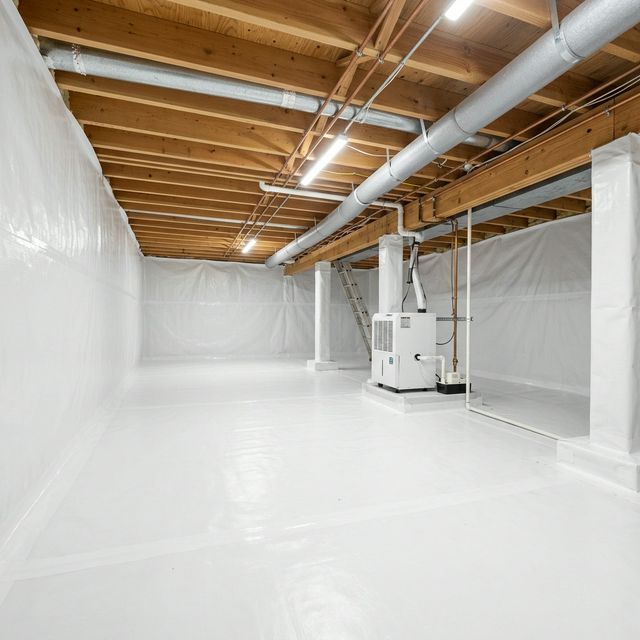
- 1 Floor framing overhead
- 2 Sealed wall liner
- 3 Dehumidifier
- 4 Liner over the ground
Correction
What we do about it
Treat the harborage, then treat the humidity, because lasting control here is a moisture project.
We treat the cracks, voids, and storage zones where silverfish harbor, but lasting control is a humidity project. That means tracing the damp source, often a vented crawl space or a poorly ventilated attic, and correcting it with the moisture side of our work: dehumidification, vapor barriers, and drying the spaces that feed the living areas above. Swapping cardboard boxes for sealed plastic bins removes the food and the nursery in one move, and it is the cheapest advice we hand out.
Not sure what you are looking at? Take a photo, save a sample if you safely can, and call 757-583-4444. Identification comes first, and it is free.
See also
Related services
Answered already
Silverfish: quick answers
Are silverfish harmful?
Not to people or pets; they do not bite or spread disease. The harm lands on irreplaceable stored things, family photos, documents, and books, plus what their presence implies about humidity. A house dry enough to protect your paper is a house silverfish struggle to live in.
Silverfish
Think you have silverfish?
Send a photo or book an inspection. We will identify what it is, what it is doing, and what fixing it takes.
757-583-4444Monday to Friday, 9 AM to 5 PM. Norfolk, Virginia Beach, and all of Hampton Roads.