
Soil to sill
Hampton Roads, VA
Subterranean Termites in Hampton Roads
The eastern subterranean termite is the single most destructive pest in coastal Virginia, and our company is named after finding it.
Determination
Reticulitermes flavipes
Mud tubes climbing from soil into wood, and a swarmer with straight antennae and a thick waist.
- Common name
- Subterranean Termites
- Report status
- Reportable on NPMA-33
- Structural risk
- Damages framing
- Settled by
- Tube and swarmer
- Lives in
- Soil
- Field indicators
- 5 listed
Description
Subterranean termites nest in soil and travel up into structures through pencil-width mud tubes, eating wood from the inside while the surface stays intact. Coastal Virginia sits in one of the heavier termite pressure regions in the country, and the conditions Hampton Roads supplies, damp soil, mild winters, and tens of thousands of crawl space homes, are close to ideal for them.
A mature colony can hold hundreds of thousands of workers feeding around the clock. They do not sleep, they do not take winters fully off in our climate, and by the time damage is visible at the surface, the interior galleries are usually well established. That gap between infestation and visibility is why annual inspections exist.
The couplet
The swarm on the window sill: termite or flying ant
This is the common spring question, and it is settled by three characters read on a single insect. Trap a few in a bag if you can, because the answer changes what happens next.
Antennae
Termite swarmer Straight
Flying ant Elbowed
Wings
Termite swarmer Equal length
Flying ant Unequal
Waist
Termite swarmer Thick
Flying ant Pinched
A swarm indoors almost always means an active colony in or under the structure. That is the finding, not the swarm itself.
Ground section
The route out of the soil
The colony is in the ground, so the section that matters runs from the soil the nest sits in, up across the piers the tubes cross, to the treated zone that goes between them.
Damp soil
Where the colony nests.
Foundation and pier line
Crossed by pencil width mud tubes.
Treated zone
Continuous, around and under the structure.
Virginia VDACS licence number
Field indicators
Evidence, in the order it is usually found
Subterranean termites eat wood from the inside while the surface stays intact, so the evidence arrives long before the damage looks like damage.
- Mud tubes climbing foundation walls, piers, or plumbing penetrations
- Swarms of winged insects indoors or outdoors in spring, usually March through June after warm rain
- Piles of shed wings on window sills after a swarm
- Wood that sounds hollow or gives under a screwdriver tip
- Blistered or bubbling paint over damaged framing
Grade level
Where it lives in the structure
Read this column from the bottom. The colony is in the soil, and everything above it is the route, not the home.
Roof and attic
Not found here
Living space
Swarmers indoors in spring, and piles of shed wings on window sills after a swarm.
Exterior wall, trim, and deck
Not found here
Sill, band, and floor framing
Wood that sounds hollow or gives under a screwdriver tip. Blistered or bubbling paint over damaged framing.
Crawl space
Mud tubes climbing foundation walls, piers, and plumbing penetrations.
Soil and grade
The nest. A mature colony can hold hundreds of thousands of workers feeding around the clock.
Consequence
What it costs to ignore
The gap between infestation and visibility is the whole reason annual inspections exist.
Interior first
By the time damage is visible at the surface, the interior galleries are usually well established.
No off season
They do not sleep, and they do not take winters fully off in our climate.
Years, not weeks
Serious structural damage usually takes years, which is good news if you catch activity early, and bad news for homes that go five or ten years between inspections.
Corrected condition
The corrected crawl space
A crawl space that has been dried and sealed removes the condition the colony was working with. This is what the correction looks like from the inside.
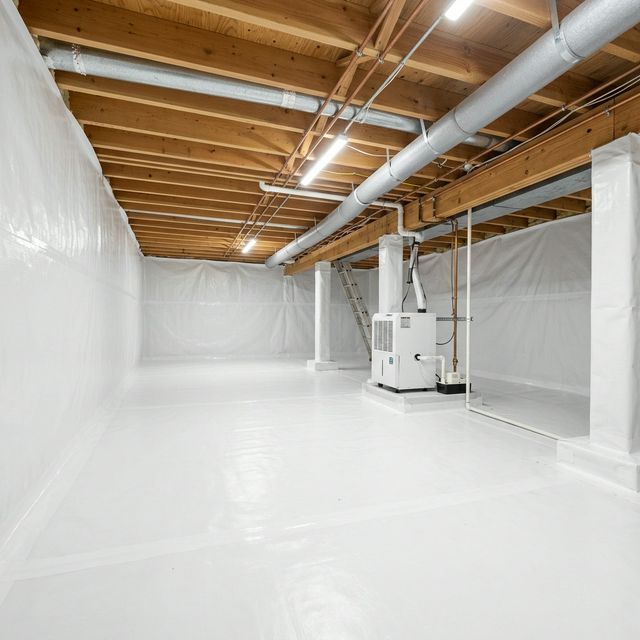
- 1 Floor framing overhead
- 2 Sealed wall liner
- 3 Dehumidifier
- 4 Liner over the ground
Correction
What we do about it
Confirm, map, treat, and then remove the condition that invited the colony.
- Activity, access points, moisture
Confirm and map
Our inspectors confirm activity, map where the structure is being accessed, and identify the moisture conditions feeding the colony.
- Continuous treated zone
Treat the soil
Treatment is a liquid soil application that creates a continuous treated zone around and under the structure, so foraging workers meet treated soil before they reach wood.
- Dry the wood, not just kill
Remove the invitation
Because moisture drives termite pressure, we also address the crawl space conditions that invited the colony. Killing the termites without drying the wood is treating the symptom and reinstalling the cause.
Not sure what you are looking at? Take a photo, save a sample if you safely can, and call 757-583-4444. Identification comes first, and it is free.
See also
Related services
Answered already
Subterranean Termites: quick answers
I saw winged insects swarming. Termites or ants?
Termite swarmers have straight antennae, equal-length wings, and a thick waist. Flying ants have elbowed antennae, unequal wings, and a pinched waist. If you can, trap a few in a bag and call us. A swarm indoors almost always means an active colony in or under the structure.
How fast do termites do real damage?
Serious structural damage usually takes years, not weeks, which is good news if you catch activity early. It is bad news for homes that go five or ten years between inspections, because the colony had that whole span to work uninterrupted.
Subterranean Termites
Think you have subterranean termites?
Send a photo or book an inspection. We will identify what it is, what it is doing, and what fixing it takes.
757-583-4444Monday to Friday, 9 AM to 5 PM. Norfolk, Virginia Beach, and all of Hampton Roads.