
Below grade / February
Are Termites Active in Winter?
A January kitchen remodel finds live termites and everyone is surprised except the termites. Coastal Virginia winters do not shut them down. Here is why.
Yes, here they are
The eastern subterranean termite does not hibernate.
Cold slows a colony and pushes it deeper into the soil, but feeding never fully stops, and a colony that already reached a heated structure barely notices the season.
Every January, some version of the same call comes in. A contractor gutting a kitchen ahead of a spring listing pulls up the old subfloor and stops: mud tubes on the band joist and live, working termites in the wood, in the middle of winter, with frost on the truck that morning. The homeowner asks the natural question. Are they not supposed to be dormant?
The short answer
In coastal Virginia, yes, they are active. The eastern subterranean termite does not hibernate. Cold slows a colony and pushes it deeper into the soil, but feeding never fully stops, and a colony that has already reached a heated structure barely notices the season at all. Workers keep foraging all winter wherever soil and structure hold their temperature, and along this coast, that is most places.
Termites do not read a calendar. They read temperature and moisture.
Grade level
Three local facts do all the work, and every one of them is a fact about what is under the lawn rather than what is above it.
Why do our winters not shut them down?
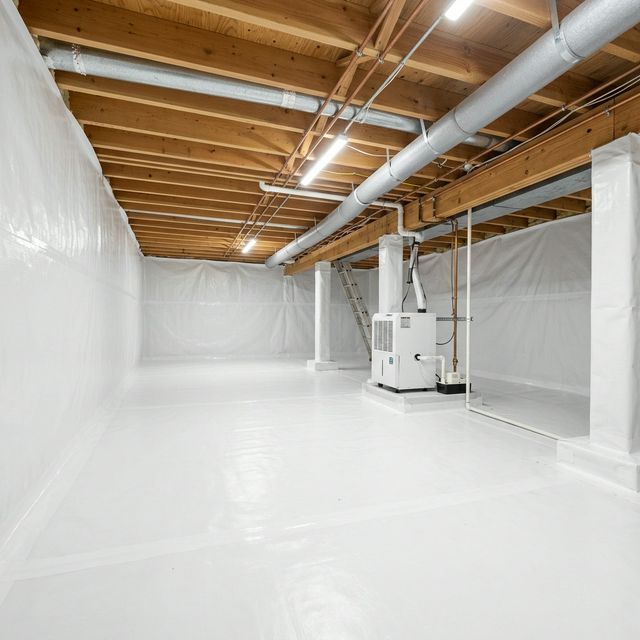
First, termites live below the frost line, and around Hampton Roads the ground rarely freezes more than a few inches down, so the colony living space stays workable even when the surface is not. Second, coastal winters here are mild and short on hard freezes; a cold snap or two does not change soil temperature at depth. Third, and biggest: this is crawl space country. A crawl space under a heated house holds a stable working temperature all winter, and a vented one stays damp on top of it. Warm enough, wet enough, wood overhead. That is the entire termite checklist, available in February.
One distinction keeps the confusion down: activity is not swarming. The dramatic winged emergence runs March through June after warm rain, which is exactly why people assume winter means safety. The season guide separates the calendar of swarming from the year round work of feeding.
Ground section, January
A few inches
Frozen crust
All the freeze this coast usually gets.
Below the frost
Colony soil
Workable temperature straight through winter.
The crawl space
Under a heated floor
Stable, damp, and roofed with framing lumber.
Months the colony takes off
Why do so many discoveries happen in winter?
Renovation, mostly. Winter is when kitchens and bathrooms get gutted ahead of spring listings and PCS moves, and demolition exposes what finished walls and flooring hid for years. There are no swarmers at the window to give the game away, so the tile crew finds it instead. If you are opening walls this winter, learn the signs of termites before demo day. And if winged insects show up near a heated slab in February, run the ant or termite check, because heated buildings occasionally trigger early indoor swarms.
Why is winter the easy time to book?
Because everyone else calls in April. Swarm season packs schedules across the whole market, while the off season is when routes have room and a liquid treatment can go down calmly, so the barrier is in place before the spring flights ever launch. Inspection conditions are better too, with vegetation down and crawl spaces at their most honest. We run the same service area all winter, Norfolk out to Williamsburg, and if your project turned up something suspicious, homeowner inspections are free when a problem is suspected. Call 757-583-4444, Monday through Friday, 9 AM to 5 PM.
Edge cases
Inland Virginia
A different climate West of the coastal plain, deeper ground freezes bring real slowdowns. This page is about the coast.
Unheated outbuildings
These do slow down A detached shed or garage without heat sees activity drop during cold stretches, then pick back up.
A winter swarm indoors
A five alarm signal Rare, but when a heated structure triggers one, the colony is inside the envelope. Do not wait for spring to act.
Moisture in January
Rules the same way A crawl space reading wet in January is exactly as attractive to a colony as one reading wet in July.
Inspection request
Book the quiet season
Tell us what you are seeing and we will confirm a time window. Inspections are free when you suspect a problem.
757-583-4444Monday to Friday, 9 AM to 5 PM. Norfolk, Virginia Beach, and all of Hampton Roads.