
Upstairs hallway / then downstairs
That Musty Smell Is Coming From Under the House
You shampooed the carpet twice and it came back by Thursday. The smell is not in the room. It is under it.
Where it comes from
Not the carpet. The crawl space.
Warm air leaks out of the top of a house and gets replaced from the lowest place available, so whatever is in the crawl space air ends up in your air, on a schedule.
The hallway by the linen closet, every August. Guests notice it and are too polite to say so. The carpet gets shampooed, the candle industry collects its cut, a plug-in goes into the outlet, and for one week the hallway smells like a pina colada fighting a basement. Then the pina colada loses. Fold together a few hundred Hampton Roads service calls and that composite hallway sits directly above the dampest corner of a vented crawl space, and those two facts are the same fact.
The house breathes from the bottom
Warm air rises and leaks out of the top of a house through can lights, the attic hatch, and the chase around the chimney. All of that air has to be replaced, and the replacement gets pulled from the lowest place available: the crawl space. Building science calls this the stack effect, and a commonly cited estimate says a large share of first floor air, sometimes approaching half, started its day under the house. Whatever is in the crawl space air ends up in your air, on a schedule, and the pull runs hardest in exactly the humid months when the crawl space is at its worst.
Grade level
The source is below the floor, not in it. Which changes what the problem is.
What the smell is
Musty is not a mystery category. That odor is mostly microbial exhaust: volatile compounds released by mold and wood decay fungi digesting damp framing, plus the earthy note of soil organisms working the wet dirt. Your nose is detecting metabolism, which reframes the situation considerably. The organisms making the smell are eating the parts of the house that hold it up, and once growth is established on framing, that is when fungus treatment joins the moisture work instead of following it.
You do not have an odor problem. You have a biology problem.
Not thisSewer gas
Sharp, and intermittent Comes and goes with drain use.
Not thisA dead animal
Peaks then fades Usually within days, and it does not come back next August.
ThisThe musty one
Steady and seasonal Strongest in humid weather and in the rooms above the crawl space, and it eases when a dehumidifier runs nearby.
The readings that ride along with it
When we put meters in a smelly crawl space, the numbers rarely surprise anyone. Relative humidity parked above 70 percent. Wood moisture pushing past the 20 percent line where decay fungi wake up. A July dew point in the 70s outside, which means the vented crawl space paradox is running: vents installed to dry the space are importing air so humid it condenses on cool joists and ductwork. Norfolk sits low and the water table sits high, so the dirt never fully dries on its own. The full numbers live in our guide to crawl space moisture readings, and the underlying causes in why local crawl spaces stay wet.
Bottom rung up
The fix ladder
Work from the bottom rung up, and stop climbing when the numbers hold.
- No liner survives standing water
Bulk water first
Gutters, downspout extensions, grading, and drainage correction. Everything above this rung is decoration until the water stops arriving.
- Stops the soil steaming the framing
Ground moisture second
A sealed vapor barrier ends the constant upward evaporation that drives most elevated readings in this region.
- The drying the vents never did
Air moisture third
Sealed vents plus a properly sized dehumidifier take outdoor dew points out of the equation.
- When you want it gone for good
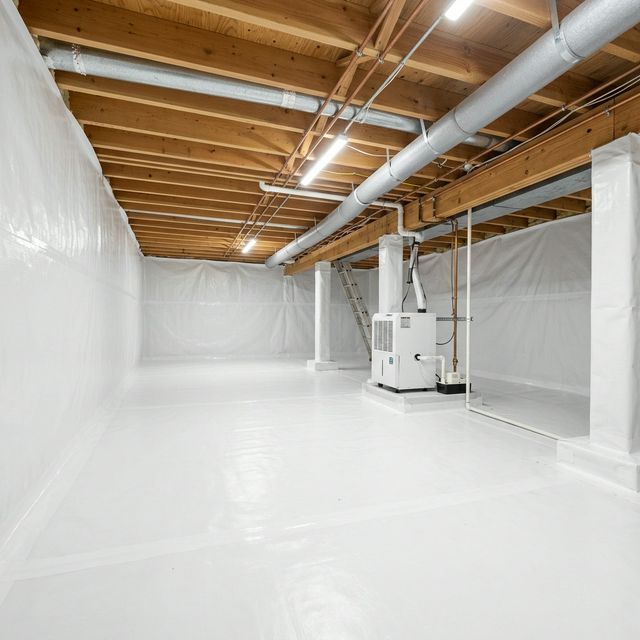
Full encapsulation
The space is brought inside the building envelope, sealed and conditioned, and the smell goes with the humidity.
Every rung is part of our moisture control work, and the right stopping point comes from the readings, not a brochure. The top rung is crawl space encapsulation. If the hallway is already announcing the problem, a homeowner inspection is free when you suspect one. Call 757-583-4444 and let the meter do the talking.
Inspection request
Smell it upstairs? The cause is usually underneath.
Tell us what you are seeing and we will confirm a time window. Inspections are free when you suspect a problem.
757-583-4444Monday to Friday, 9 AM to 5 PM. Norfolk, Virginia Beach, and all of Hampton Roads.